
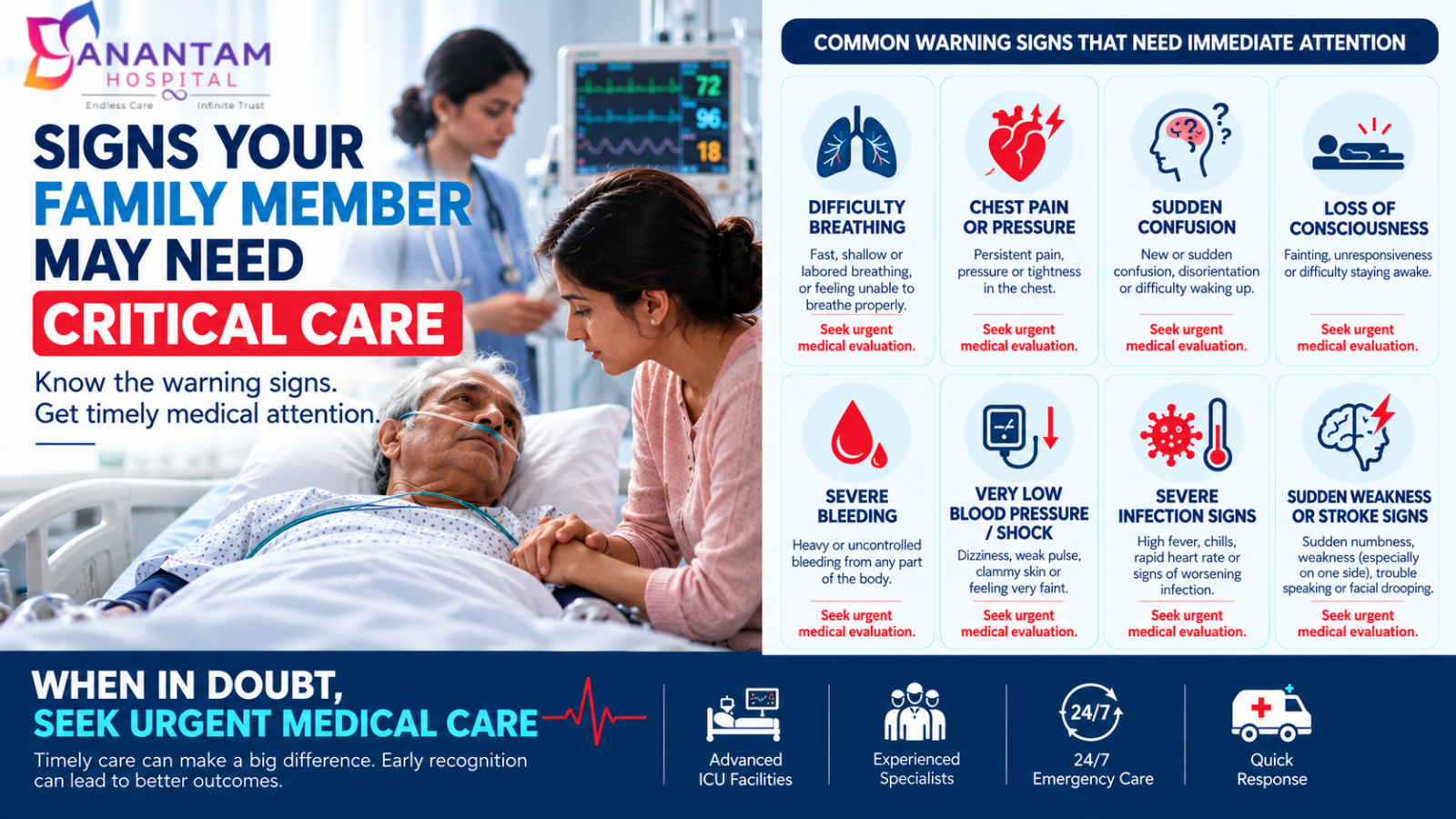
When a person you care about suddenly feels unwell, it can be confusing to decide whether the situation can wait until morning or if it is an emergency. Recognizing the signs of critical illness is vital because it can mean the difference between receiving timely treatment and suffering a dangerous delay. Many families pause, hoping that the symptoms will calm down by themselves. This pause can cost precious time.
This guide explains the essential signs of critical illness how they may appear at home and what steps to take next. At Anantam Hospital in Khadakpada, Kalyan our critical care team collaborates with 24/7 emergency care to treat patients whose condition is serious or rapidly worsening.
What Is Critical Care?
Critical care is treatment for people who face life‑threatening illness or injury. It is provided in an intensive care unit (ICU) where doctors and nurses keep a close eye on breathing, heart rate, blood pressure and organ function. They can also support the body with oxygen, medicines and advanced equipment whenever it is required.
A patient may need critical care after a heart attack, a stroke, a severe infection a major accident, a serious breathing problem or complications that arise after surgery.
Key Signs of Critical Illness You Should Never Ignore
– Difficulty breathing: struggling for breath breathing fast unable to say a full sentence or noisy laboured breathing.
– Chest pain or pressure: pain, tightness or heaviness in the chest especially if it spreads to the arm, jaw or back or comes with sweating.
– Confusion or unusual drowsiness: confusion, disorientation hard to wake the person or unresponsiveness.
– Blue, pale or grey lips and skin: this can show that the body is not getting enough oxygen.
– Fast heartbeat, dizziness or fainting: especially if the person also looks pale, sweaty or has cold clammy skin.
– High fever with shivering or confusion: infection that spreads through the body (sepsis) can worsen quickly.
– Sudden weakness or a drooping face: weakness on one side slurred speech or trouble understanding speech may point to a stroke.
– Seizures: especially the first seizure, one that lasts more than a few minutes or repeated seizures.
– Severe bleeding or major injury: bleeding that does not stop with pressure or injuries from an accident or fall.
– Persistent Vomiting or very little urine: this may signal severe dehydration or organ stress especially in the elderly and children.
If you notice more than one of these signs of critical illness together or if a symptom is getting worse quickly do not wait.
Signs of Critical Illness in Older Adults, Children and Pregnant Women
Symptoms can look different depending on age and health.
– Older adults may not have a fever or obvious pain. New confusion, sleepiness, a sudden fall or refusing food and water can be early warning signs.
– Children may become unusually limp or difficult to wake breathe fast refuse feeds or have fewer wet nappies or less urine than normal.
– Pregnant women should seek care for severe headache, blurred vision, heavy bleeding reduced baby movements, breathlessness or seizures.
– People with long‑term conditions such as diabetes, heart disease, kidney disease or cancer can deteriorate faster so a lower threshold for seeking help is safer.
Ambulance or Emergency Department: What Should You Do?
If someone is unconscious struggling to breathe has chest pain, a seizure or heavy bleeding call an ambulance instead of driving them yourself. Trained staff can start care on the way and alert the hospital ahead of time. In India you can call 108 for an ambulance. Contact the hospital’s emergency number directly.
If the person is stable but you are worried for example a fever that will not go down or ongoing vomiting bring them to the emergency department for evaluation.
What to Do While Waiting for Help
Stay calm and keep the person in a comfortable position. Do not force them to eat or drink. If the person is unconscious but breathing lay them on their side. Apply firm, pressure to any bleeding with a clean cloth. Loosen clothing and keep the person warm. Keep a list of their medicines, allergies and medical conditions ready along with reports and prescriptions. Do not give medicines on your own unless a doctor advises it. Anyone trained in CPR should begin it if the person is unresponsive and not breathing normally while help is on the way.
– Stay calm. Keep the person in a safe comfortable position.
– Do not force them to eat or drink.
– If the person is unconscious but breathing lay them on their side.
– Apply firm, pressure to any bleeding with a clean cloth.
– Loosen tight clothing and keep the person warm.
– Keep a list of their medicines, allergies and medical conditions ready along, with reports and prescriptions.
– Do not give medicines on your own unless a doctor advises it.
What Happens in Critical Care?
When a patient arrives in critical care the medical team first steadies the breathing and circulation. Then the team looks for the reason for the illness using tests and scans. Treatment may involve oxygen support, ventilator support, medicines delivered through a drip close monitoring of signs and care from many specialists working together.
Families are kept informed about the patient’s condition and the treatment plan. It is normal to feel anxious. Asking questions to the care team helps families understand what is happening.
Critical Care at Anantam Hospital, Kalyan
Anantam Hospital, located in Khadakpada, Kalyan offers critical care, a trauma team, door‑step ambulance service, emergency operation theatres and 24‑hour emergency readiness under one roof. When minutes matter having emergency care, critical care and many specialists in one hospital helps avoid delays in treatment.
If you notice the signs of illness in a family member call the emergency team right away or bring the patient straight to the hospital.
Frequently Asked Questions
How do I know if my family member needs ICU care?
Severe breathing difficulty, chest pain, confusion, unresponsiveness, seizures, heavy bleeding or a worsening condition are reasons to seek emergency care right away. The doctors then decide whether ICU admission is needed.
Can high fever be a sign of critical illness?
A fever alone is often not serious. A high fever with confusion shivering, fast breathing or extreme weakness may point to a severe infection and needs urgent evaluation.
Should I take the patient to the hospital myself or call an ambulance?
For life‑threatening symptoms call an ambulance. Trained staff can start care on the way. If the person is stable you may bring them to the emergency department.
Is it better to wait and watch at home?
If symptoms are severe, sudden or worsening do not wait. Early treatment often leads to better outcomes.


Add a Comment