

Urinary Tract Infections and Treatment at Anantam Hospital

All You Must Know About Urinary Tract Infections and Treatment

Do you remember that burning sensation every time you urinated followed by urgent feeling that you need to urinate all over again in 5 minutes? Yep, you have most probably got a UTI infection, and this problem affects many people. Urinary tract infections are very common but somehow still under-discussed problem. Proper treatment of urinary tract infections and treatment requires knowing about it in detail.

UTI Definition

UTI stands for urinary tract infection. UTI infection happens when bacteria infect your urinary system. It may affect your bladder, urethra, or even your kidneys in case of advanced infection.

UTIs are more common among women because of their anatomy. Women tend to have shorter urethra and because of that, it is easier for bacteria to enter into their bladder.

Possible Symptoms

You always feel that something is going wrong before realizing that you are sick. Here are the symptoms of UTI infections.

Symptoms of UTIs include:

  • Burning sensation during urination
  • Strong desire to urinate even when only a small amount of urine leaves your body
  • Cloudy or strongly smelling urine
  • Pain in lower abdomen or pelvic area
  • General feeling of weakness

In case if the listed symptoms are accompanied by fever, chills, or pain in back – it is time to visit a doctor for proper UTI treatment.

The Causes of Urinary Tract Infections

Several things may cause UTIs, and the knowledge of them will help you to avoid such problems in the future.

  • Lack of proper hydration, which means less frequent visits to bathroom and inability to flush out the bacteria
  • Holding of urine for too long, which gives the bacteria more time to multiply
  • Using of certain contraceptives (like diaphragm and spermicide)
  • Pregnancy, which is associated with changes of hormonal level and physical changes in the urinary tract
  • Diabetes, because of high levels of sugar in your blood, which encourages bacterial growth
  • Poor hygiene practices, like improper wiping after using a toilet

None of the listed factors guarantees the appearance of UTIs, but they certainly increase your chances to get them, and they are helpful for the doctors to diagnose your situation and provide you with proper UTI treatment.

Ways to Treat UTI Infections

This is the part when people usually mess everything and try to manage the situation without appropriate diagnosis.

Common treatment options for UTIs include:

  • The use of antibiotics, depending on the type of bacteria causing the infection
  • Increase in the intake of water to flush the bacteria along with taking antibiotics
  • Pain killers for dealing with pain while antibiotics work their way
  • Completion of a full antibiotic course even when feeling better after 1-2 days

This is how things really are. Antibiotics should be used with the proper diagnosis; guessing does not do any good.

Why is Self-Medicating the Wrong Solution?

Although it is quite tempting to go for self-medication, this solution poses certain risks.

In particular, inappropriate use of an antibiotic may lead to developing resistance to it, which will make treating the next infection even more difficult. Moreover, the symptoms might just go away while the infection progresses to the kidneys.

In Case of Recurrent UTIs

However, recurrent UTIs are a sign you should look into instead of following the same treatment process.

The cause for the recurrence can be:

  • Some problem with the body’s anatomy
  • The previous infection was not completely cured
  • Some of the daily routines or hygiene practices should change
  • In rare occasions – an altogether different illness like diabetes

You will be advised to take tests to see what the cause for the recurrence is.

Habits You Should Adopt in Order to Protect Yourself

There are some routines and habits that really reduce the chance of UTIs.

  1. Drinking plenty of fluids during the day
  2. Going to the toilet whenever you have the urge to, without holding it in
  3. Wiping from front to back, particularly for females
  4. Urinating after sex, as it flushes bacteria out
  5. Avoiding unnecessary use of strong feminine hygiene products, since it disturbs the balance of bacteria

When to Rush to the Doctor

UTIs are mostly easy to manage, but there are some indications when immediate medical help is needed.

You should go to a doctor when:

  • There are fever or chills along with UTI symptoms
  • There is pain in the sides or back, suggesting kidney involvement
  • You see blood in the urine
  • You have had symptoms for several days, despite home remedies

These are not symptoms to ignore especially if there is a risk of kidneys being involved.

Conclusion

UTIs are common, troublesome and completely treatable if you get the proper care instead of going at it alone. Knowing their causes, symptoms and possible treatments makes it much easier to react to them instead of enduring them unnecessarily.

In case UTI symptoms are dragging on or keep recurring, don’t just tough it out. Anantam Hospital is the best multispeciality hospital in Kalyan and provides dedicated Urology consultations.
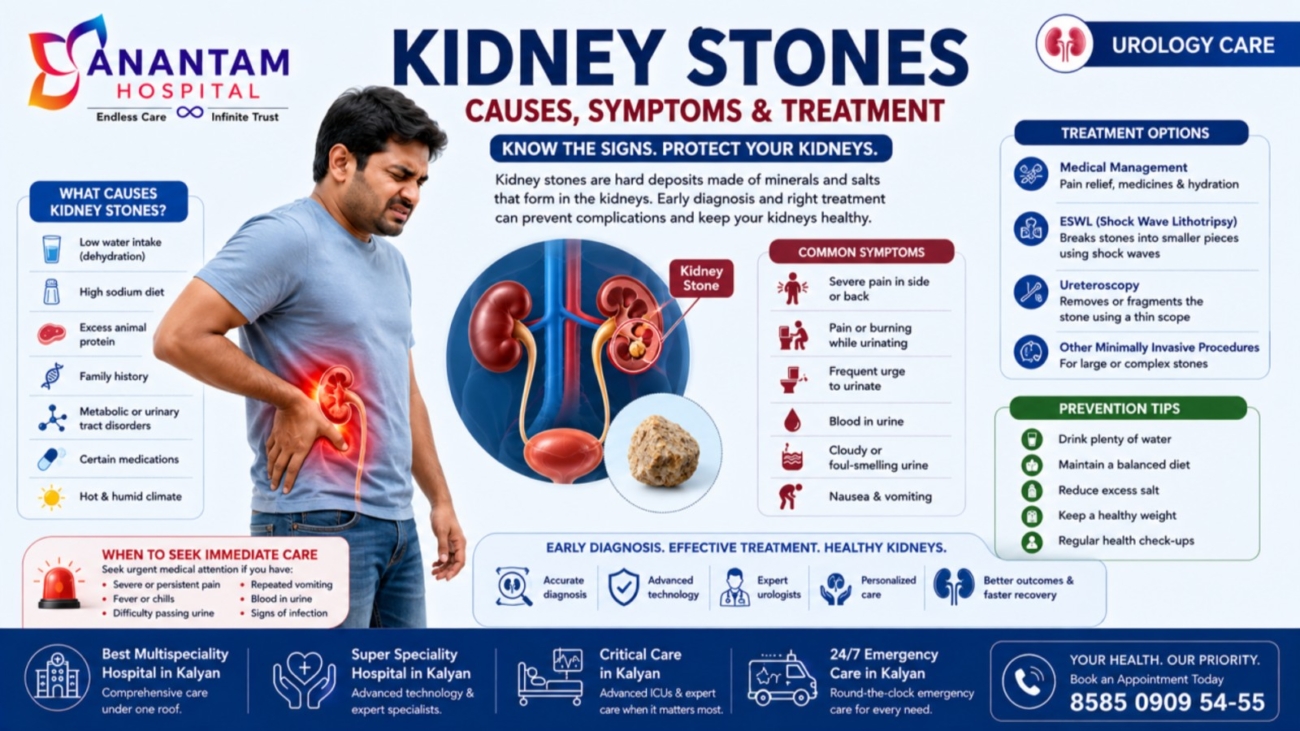
Kidney stones causes, symptoms & treatment – Anantam Hospital

Kidney Stones – Causes, Symptoms & Treatment

Kidney stones are a common urinary system problem that can affect people of different ages. They develop when certain minerals and salts present in urine become highly concentrated and form hard deposits inside the kidneys. Some kidney stones are very small and may pass naturally through the urinary tract, while larger stones can cause significant pain, blockage, infection, and other complications.

Understanding the causes, symptoms, treatment options, and prevention of kidney stones can help you recognize the condition early and seek appropriate medical care.

At Anantam Hospital, the Best Multispeciality Hospital in Kalyan, our experienced specialists provide comprehensive evaluation and treatment for kidney and urinary tract conditions using advanced diagnostic facilities and patient-focused care.

What Are Kidney Stones?

Kidney stones are hard, crystal-like deposits that form inside the kidneys when substances such as calcium, oxalate, uric acid, or other minerals become concentrated in the urine. A stone may remain inside the kidney without causing symptoms or travel through the ureter, the tube connecting the kidney to the bladder.

The size and location of a stone largely determine whether it will cause symptoms. Smaller stones may pass through the urinary tract without medical intervention, whereas larger stones can become lodged and obstruct the normal flow of urine.

What Causes Kidney Stones?

Several factors can contribute to kidney stone formation. Not drinking enough water is one of the most important risk factors because concentrated urine makes it easier for minerals to crystallize. A diet high in sodium may also increase the risk of certain stones, while excessive intake of some animal proteins can contribute to stone formation in susceptible individuals.

Family history can increase the likelihood of developing kidney stones. People who have had kidney stones previously may also be more likely to develop them again. Certain medical conditions, metabolic disorders, urinary tract problems, and some medications can increase the risk as well.

Hot and humid environments can also contribute indirectly because excessive sweating without adequate fluid replacement may lead to dehydration and more concentrated urine.

Common Symptoms of Kidney Stones

A small kidney stone may not cause any symptoms until it begins moving. When a stone travels through the urinary tract, it can cause sudden and intense pain. The pain may occur in the side or back and can sometimes spread toward the lower abdomen or groin.

Other symptoms may include pain or burning while urinating, a frequent urge to urinate, blood in the urine, cloudy or foul-smelling urine, nausea, and vomiting. Some people may experience pain that comes and goes in waves as the stone moves.

A kidney stone accompanied by fever or chills may indicate an infection and requires prompt medical evaluation.

Where Does Kidney Stone Pain Occur?

Kidney stone pain can vary depending on where the stone is located. It commonly begins in the back or side below the ribs and may move toward the lower abdomen or groin as the stone travels down the ureter.

The intensity of the pain can also change as the stone moves. Some people describe it as severe, cramping pain that comes in waves. However, symptoms can vary considerably from person to person.

How Are Kidney Stones Diagnosed?

Doctors begin with a medical history and physical examination. Urine and blood tests may be performed to look for signs of infection, blood in the urine, or factors that may contribute to stone formation.

Imaging plays an important role in diagnosis. An ultrasound may be used to identify stones and assess whether urine flow is obstructed. Depending on the situation, doctors may recommend additional imaging such as a CT scan to determine the size and exact location of the stone.

Accurate diagnosis helps doctors decide whether the stone can pass naturally or requires medical or surgical treatment.

How Are Kidney Stones Treated?

Treatment depends on the stone’s size, location, composition, symptoms, and whether it is causing an obstruction or infection. Small stones may pass naturally with adequate fluid intake and appropriate pain management under medical guidance.

When a stone is unlikely to pass on its own or is causing significant symptoms, a urologist may recommend a procedure to remove or break it into smaller pieces.

One commonly used treatment is Extracorporeal Shock Wave Lithotripsy (ESWL), which uses focused shock waves to break certain kidney stones into smaller fragments that can then pass through the urinary tract.

Another option is ureteroscopy, where a thin specialized instrument is passed through the urinary tract to locate and remove or fragment the stone. For larger or more complex stones, other minimally invasive procedures may be recommended depending on the patient’s condition.

The appropriate treatment should always be decided by a qualified urologist after evaluating the individual patient.

When Does a Kidney Stone Become an Emergency?

Most kidney stones can be treated effectively, but certain symptoms require urgent medical attention. Severe or persistent pain, fever or chills, difficulty passing urine, repeated vomiting, significant blood in the urine, or symptoms suggesting a urinary infection should not be ignored.

A blocked urinary tract combined with an infection can become a serious medical emergency. Prompt treatment is essential to prevent complications and protect kidney function.

If you experience severe symptoms, seek immediate medical attention rather than attempting to manage the condition on your own.

Can Kidney Stones Be Prevented?

Once someone has developed a kidney stone, making certain lifestyle changes may help reduce the risk of recurrence. Drinking enough water throughout the day is one of the most important preventive measures. Your doctor may recommend a specific fluid intake depending on your health and individual risk factors.

Reducing excessive salt intake, maintaining a balanced diet, and avoiding unnecessary dietary restrictions without medical advice can also help. The recommended diet may vary depending on the type of stone, so people with recurrent kidney stones may benefit from a metabolic evaluation and personalized dietary guidance.

Maintaining a healthy weight and managing medical conditions that increase stone risk are also important for long-term prevention.

Why Do Kidney Stones Keep Coming Back?

Some people experience kidney stones repeatedly. Recurrence can be associated with inadequate fluid intake, dietary factors, family history, certain medical conditions, or the chemical composition of previous stones.

If you have had kidney stones more than once, your doctor may recommend testing the stone itself, analyzing urine, or performing blood tests to understand why the stones are forming. Identifying the underlying cause can help create a more effective prevention plan.

Why Choose Anantam Hospital for Kidney Stone Treatment?

Kidney stone treatment requires accurate diagnosis and the right treatment approach based on the individual patient’s condition. At Anantam Hospital, the Best Multispeciality Hospital in Kalyan, patients receive comprehensive evaluation and treatment supported by experienced specialists and advanced diagnostic facilities.

As a Super Speciality Hospital in Kalyan, Anantam Hospital provides multidisciplinary care for complex kidney and urinary tract conditions. Patients can access advanced imaging, laboratory investigations, specialist consultations, minimally invasive treatment options, and postoperative care under one roof.

For patients requiring close monitoring or advanced medical support, our Critical Care in Kalyan provides specialized care, while our 24/7 Emergency Care in Kalyan ensures that urgent medical conditions can be assessed and treated without unnecessary delay.

Kidney stones can range from small stones that pass naturally to larger stones that cause severe pain, urinary obstruction, or infection. Recognizing symptoms early and obtaining an accurate diagnosis can help prevent complications and ensure timely treatment.

Adequate hydration, a balanced diet, and appropriate medical evaluation can also play an important role in preventing future stones. If you experience severe side or back pain, painful urination, blood in the urine, fever, vomiting, or difficulty passing urine, consult a healthcare professional promptly.

At Anantam Hospital – the Best Multispeciality Hospital in Kalyan, our experienced specialists and advanced facilities provide comprehensive kidney and urinary care with a patient-first approach. Whether you require diagnostic evaluation, medical management, minimally invasive treatment, Critical Care in Kalyan, or 24/7 Emergency Care in Kalyan, our team is committed to helping you receive timely and appropriate care.