
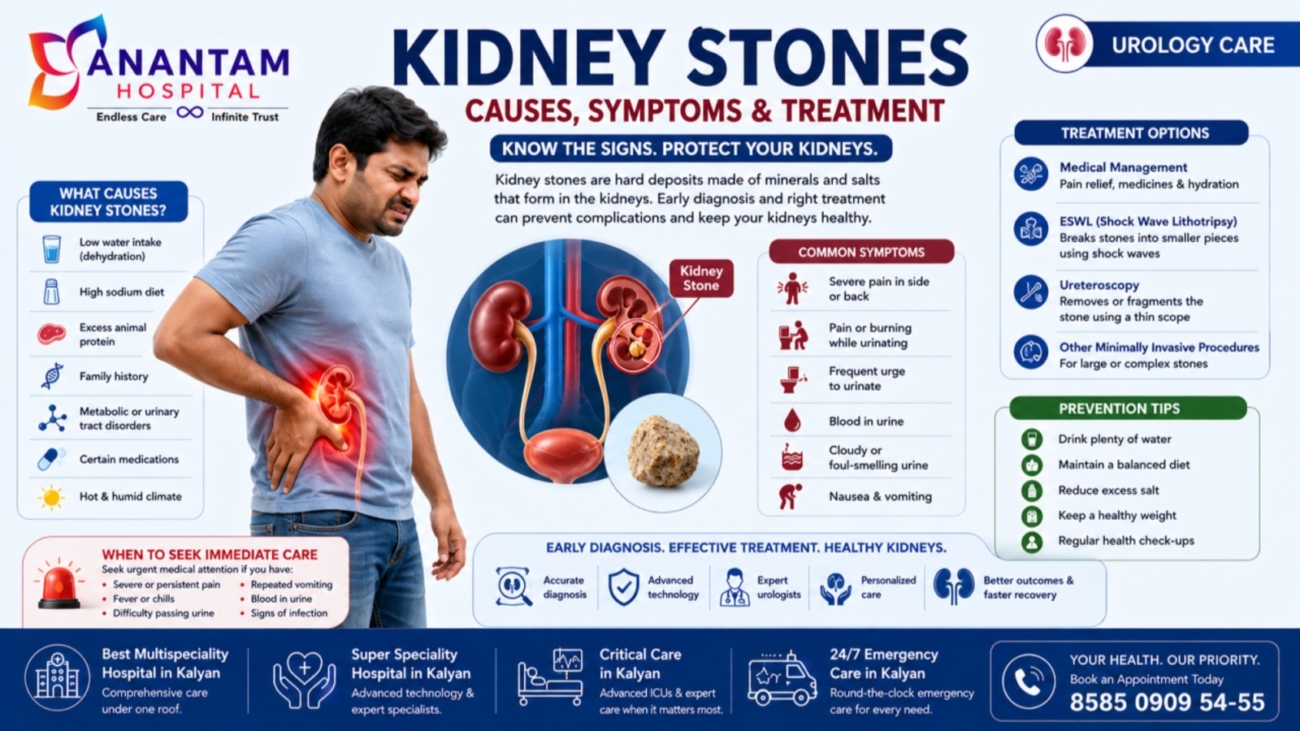
Kidney stones are a common urinary system problem that can affect people of different ages. They develop when certain minerals and salts present in urine become highly concentrated and form hard deposits inside the kidneys. Some kidney stones are very small and may pass naturally through the urinary tract, while larger stones can cause significant pain, blockage, infection, and other complications.
Understanding the causes, symptoms, treatment options, and prevention of kidney stones can help you recognize the condition early and seek appropriate medical care.
At Anantam Hospital, the Best Multispeciality Hospital in Kalyan, our experienced specialists provide comprehensive evaluation and treatment for kidney and urinary tract conditions using advanced diagnostic facilities and patient-focused care.
What Are Kidney Stones?
Kidney stones are hard, crystal-like deposits that form inside the kidneys when substances such as calcium, oxalate, uric acid, or other minerals become concentrated in the urine. A stone may remain inside the kidney without causing symptoms or travel through the ureter, the tube connecting the kidney to the bladder.
The size and location of a stone largely determine whether it will cause symptoms. Smaller stones may pass through the urinary tract without medical intervention, whereas larger stones can become lodged and obstruct the normal flow of urine.
What Causes Kidney Stones?
Several factors can contribute to kidney stone formation. Not drinking enough water is one of the most important risk factors because concentrated urine makes it easier for minerals to crystallize. A diet high in sodium may also increase the risk of certain stones, while excessive intake of some animal proteins can contribute to stone formation in susceptible individuals.
Family history can increase the likelihood of developing kidney stones. People who have had kidney stones previously may also be more likely to develop them again. Certain medical conditions, metabolic disorders, urinary tract problems, and some medications can increase the risk as well.
Hot and humid environments can also contribute indirectly because excessive sweating without adequate fluid replacement may lead to dehydration and more concentrated urine.
Common Symptoms of Kidney Stones
A small kidney stone may not cause any symptoms until it begins moving. When a stone travels through the urinary tract, it can cause sudden and intense pain. The pain may occur in the side or back and can sometimes spread toward the lower abdomen or groin.
Other symptoms may include pain or burning while urinating, a frequent urge to urinate, blood in the urine, cloudy or foul-smelling urine, nausea, and vomiting. Some people may experience pain that comes and goes in waves as the stone moves.
A kidney stone accompanied by fever or chills may indicate an infection and requires prompt medical evaluation.
Where Does Kidney Stone Pain Occur?
Kidney stone pain can vary depending on where the stone is located. It commonly begins in the back or side below the ribs and may move toward the lower abdomen or groin as the stone travels down the ureter.
The intensity of the pain can also change as the stone moves. Some people describe it as severe, cramping pain that comes in waves. However, symptoms can vary considerably from person to person.
How Are Kidney Stones Diagnosed?
Doctors begin with a medical history and physical examination. Urine and blood tests may be performed to look for signs of infection, blood in the urine, or factors that may contribute to stone formation.
Imaging plays an important role in diagnosis. An ultrasound may be used to identify stones and assess whether urine flow is obstructed. Depending on the situation, doctors may recommend additional imaging such as a CT scan to determine the size and exact location of the stone.
Accurate diagnosis helps doctors decide whether the stone can pass naturally or requires medical or surgical treatment.
How Are Kidney Stones Treated?
Treatment depends on the stone’s size, location, composition, symptoms, and whether it is causing an obstruction or infection. Small stones may pass naturally with adequate fluid intake and appropriate pain management under medical guidance.
When a stone is unlikely to pass on its own or is causing significant symptoms, a urologist may recommend a procedure to remove or break it into smaller pieces.
One commonly used treatment is Extracorporeal Shock Wave Lithotripsy (ESWL), which uses focused shock waves to break certain kidney stones into smaller fragments that can then pass through the urinary tract.
Another option is ureteroscopy, where a thin specialized instrument is passed through the urinary tract to locate and remove or fragment the stone. For larger or more complex stones, other minimally invasive procedures may be recommended depending on the patient’s condition.
The appropriate treatment should always be decided by a qualified urologist after evaluating the individual patient.
When Does a Kidney Stone Become an Emergency?
Most kidney stones can be treated effectively, but certain symptoms require urgent medical attention. Severe or persistent pain, fever or chills, difficulty passing urine, repeated vomiting, significant blood in the urine, or symptoms suggesting a urinary infection should not be ignored.
A blocked urinary tract combined with an infection can become a serious medical emergency. Prompt treatment is essential to prevent complications and protect kidney function.
If you experience severe symptoms, seek immediate medical attention rather than attempting to manage the condition on your own.
Can Kidney Stones Be Prevented?
Once someone has developed a kidney stone, making certain lifestyle changes may help reduce the risk of recurrence. Drinking enough water throughout the day is one of the most important preventive measures. Your doctor may recommend a specific fluid intake depending on your health and individual risk factors.
Reducing excessive salt intake, maintaining a balanced diet, and avoiding unnecessary dietary restrictions without medical advice can also help. The recommended diet may vary depending on the type of stone, so people with recurrent kidney stones may benefit from a metabolic evaluation and personalized dietary guidance.
Maintaining a healthy weight and managing medical conditions that increase stone risk are also important for long-term prevention.
Why Do Kidney Stones Keep Coming Back?
Some people experience kidney stones repeatedly. Recurrence can be associated with inadequate fluid intake, dietary factors, family history, certain medical conditions, or the chemical composition of previous stones.
If you have had kidney stones more than once, your doctor may recommend testing the stone itself, analyzing urine, or performing blood tests to understand why the stones are forming. Identifying the underlying cause can help create a more effective prevention plan.
Why Choose Anantam Hospital for Kidney Stone Treatment?
Kidney stone treatment requires accurate diagnosis and the right treatment approach based on the individual patient’s condition. At Anantam Hospital, the Best Multispeciality Hospital in Kalyan, patients receive comprehensive evaluation and treatment supported by experienced specialists and advanced diagnostic facilities.
As a Super Speciality Hospital in Kalyan, Anantam Hospital provides multidisciplinary care for complex kidney and urinary tract conditions. Patients can access advanced imaging, laboratory investigations, specialist consultations, minimally invasive treatment options, and postoperative care under one roof.
For patients requiring close monitoring or advanced medical support, our Critical Care in Kalyan provides specialized care, while our 24/7 Emergency Care in Kalyan ensures that urgent medical conditions can be assessed and treated without unnecessary delay.
Kidney stones can range from small stones that pass naturally to larger stones that cause severe pain, urinary obstruction, or infection. Recognizing symptoms early and obtaining an accurate diagnosis can help prevent complications and ensure timely treatment.
Adequate hydration, a balanced diet, and appropriate medical evaluation can also play an important role in preventing future stones. If you experience severe side or back pain, painful urination, blood in the urine, fever, vomiting, or difficulty passing urine, consult a healthcare professional promptly.
At Anantam Hospital – the Best Multispeciality Hospital in Kalyan, our experienced specialists and advanced facilities provide comprehensive kidney and urinary care with a patient-first approach. Whether you require diagnostic evaluation, medical management, minimally invasive treatment, Critical Care in Kalyan, or 24/7 Emergency Care in Kalyan, our team is committed to helping you receive timely and appropriate care.

